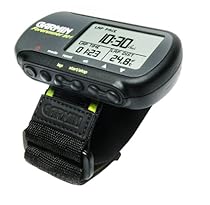
How electronic Garmin Forerunner 201

Posted by fadlian.blogspot.com | 04:47 | 0 comments »

Product Details
Garmin Forerunner 201 Wrist-Mounted GPS Fitness Computer

Garmin Forerunner 201 Wrist-Mounted GPS Fitness Computer
From Garmin

List Price: $167.99
Price: $119.99 & eligible for FREE Super Saver Shipping on orders over $25. Details

Availability: Usually ships in 24 hours
Ships from and sold by Amazon.com

32 new or used available from $90.00

Average customer review:

Free Automotive Part Finder Market

Posted by fadlian.blogspot.com | 04:23 | 0 comments »


Auto Accessories(42732) Auto Electrical System(13496) Auto Electronics(28316)
Auto Maintenance(15539) Auto Production Line Equipment(655) Auto Parts(56047)
Automobile(10453) Automobile & Parts Agent(5117) Automobile Stocks(325)
Electric Motorcycles(1648) Motorcycles(9035) Motorcycle Accessories(3528)
Motorcycle Parts(4151) Parking(1472) Second Hand(917)
Special Transportation Equipment(4661) Others(1330)

Music AC/DC electronic

Posted by fadlian.blogspot.com | 02:24 | 1 comments »

AC/DC
The band moved to Melbourne the following year, where drummer Phil Rudd (formerly of the Coloured Balls) and bassist Mark Evans joined the band. The band's chauffeur, Bon Scott, became their lead vocalist when their singer, Dave Evans, refused to go on-stage.

Previously, Scott had been vocalist for the Australian prog rock bands Fraternity and the Valentines. More importantly, he helped cement the group's image as brutes -- he had several convictions on minor criminal offenses and was rejected by the Australian Army for being "socially maladjusted." And AC/DC was socially maladjusted. Throughout their career they favored crude double entendres and violent imagery, all spiked with a mischievous sense of fun.

The group released two albums -- High Voltage and TNT -- in Australia in 1974 and 1975. Material from the two records comprised the 1976 release High Voltage in the U.S. and U.K.; the group also toured both countries. Dirty Deeds Done Dirt Cheap followed at the end of the year. Evans left the band at the beginning of 1977, with Cliff Williams taking his place. In the fall of 1977, AC/DC released Let There Be Rock, which became their first album to chart in the U.S.

Powerage, released in spring of 1978, expanded their audience even further, thanks in no small part to their dynamic live shows (which were captured on 1978's live If You Want Blood, You've Got It). What really broke the doors down for the band was the following year's Highway to Hell, which hit number 17 in the U.S. and number eight in the U.K., becoming the group's first million-seller.

AC/DC's train was derailed when Bon Scott died on February 20, 1980. The official coroner's report stated he had "drunk himself to death." In March, the band replaced Scott with Brian Johnson. The following month, the band recorded Back in Black, which would prove to be their biggest album, selling over ten million copies in the U.S. alone. For the next few years, the band was one of the largest ock bands in the world, with For Those About to Rock We Salute You topping the charts in the U.S. In 1982, Rudd left the band; he was replaced by Simon Wright.

After 1983's Flick of the Switch, the band's commercial standing began to slip; they were able to reverse their slide with 1990's The Razor's Edge, which spawned the hit "Thunderstruck." While not the commercial powerhouse they were during the late '70s and early '80s, the '90s saw them maintain their status as a top international concert draw. In the fall of 1995, their 16th album, Ballbreaker, was released. Produced by Rick Rubin, the album received some of the most positive reviews of AC/DC's career. Ballbreaker entered the American charts at number four and sold over a million copies in its first six months of release. Stiff Upper Lip followed in early 2000. ~ Stephen Thomas Erlewine, All Music Guide


Buy AC/DC Tickets Now!
Buy AC/DC Music

What Electronic ReedLogic Video Seminar.

Posted by fadlian.blogspot.com | 00:18 | 0 comments »

Research and Markets: The Top 5 Billable Areas for 2008 Bankruptcy/Restructuring & How They Can Grow Your Practice: ReedLogic Video Seminar.


DUBLIN, Ireland -- Research and Markets (http://www.researchandmarkets.com/research/364777/the_top_5_billable) has announced the addition of the "The Top 5 Billable Areas for 2008 Bankruptcy/Restructuring & How They Can Grow Your Practice: ReedLogic Video Seminar with Mark Berman" report to their offering.

ReedLogic is pleased to present a video seminar on "The Top 5 Billable Areas for 2008 Bankruptcy/Restructuring & How They Can Grow Your Practice." The 60-minute video is led by Mark Berman of Nixon Peabody Nixon Peabody LLP is one of the largest multipractice law firms in the United States, with offices in seventeen cities and more than seven hundred attorneys collaborating across twenty-five major practice areas. and can be downloaded to your computer or iPod, and is sent to you on DVD DVD: see digital versatile disc.
DVD
in full digital video disc or digital versatile disc

Type of optical disc. The DVD represents the second generation of compact-disc (CD) technology.
. This seminar is guaranteed to enhance your current strategies with new ideas and key points that will have an immediate impact on your client strategies that you can begin using right away in your practice.

The video seminar focuses on:

- A detailed look at the most up-to-date and successful bankruptcy best practices and client strategies

- What clients look for when hiring a lawyer/firm for such situations

- New strategies being used to evaluate legal exposure and new ways to proceed

- Analyzing the latest changes in applicable laws and how to capitalize on Cap´i`tal`ize on`

v. t. 1. To turn (an opportunity) to one's advantage; to take advantage of (a situation); to profit from; as, to capitalize on an opponent's mistakes s>.
them

- Case studies and what they mean for current clients

Personalize per·son·al·ize
tr.v. per·son·al·ized, per·son·al·iz·ing, per·son·al·iz·es
1. To take (a general remark or characterization) in a personal manner.

2. To attribute human or personal qualities to; personify.
the insights of the keynote speaker in this video to enhance your own best practices, develop ideas for landing more clients, and stay up to date on the latest thought leadership.

ReedLogic videos are: 1. Faster to watch than reading a printed book; 2. Interactive and prompt you with questions to spur your own ideas; 3. More convenient than traveling to a seminar and can be viewed on-demand; 4. Perfect for downtime in your office, on a business trip, while traveling or even at the gym.

Praise for ReedLogic Videos:

"A tremendous time saver for the busy attorney..." - Michael Goshko, Partner, Burns & Levinson

"Thorough, informative and interesting - these videos are an efficient, effective means of gaining in-depth insight..." - Greg Nowak, Partner, Pepper Hamilton Pepper Hamilton LLP is a law firm founded in 1890 by George Wharton Pepper. Notable cases
  • Federal League Baseball Case
  • Myers v. United States
  • United States v. Smith, 286 U.S.


"ReedLogic Seminars are an invaluable provider of this important information." - Ira Bogner, Partner, Proskauer Rose Founded in 1875, Proskauer Rose, formerly known as Proskauer Rose Goetz & Mendelsohn, LLP, is one of the United States' largest and prestigious law firms, providing a wide variety of legal services to clients throughout the United States and around the world from offices in New

For more information visit http://www.researchandmarkets.com/research/364777/the_top_5_billable

Indian Mobile Communications Industry

Posted by fadlian.blogspot.com | 00:17 | 0 comments »

Examine the Major Operators in the Indian Mobile Communications Industry with this Comprehensive Report.


DUBLIN, Ireland -- Research and Markets (http://www.researchandmarkets.com/research/62b83b/india_mobile_com) has announced the addition of the "India - Mobile Communications - Major Operators" report to their offering.

The dynamic Indian mobile telephony market has seen a number of important takeovers and mergers, resulting in significant shifts in market share among the players. Initially three major private players - Hutchison Telecom (subsequently acquired by Vodafone), Bharti, and Idea Cellular - emerged from the fray to do battle. The entry of the state-owned enterprises -BSNL and MTNL MTNL Mahanagar Telephone Nigam Limited (telecom provider in India) - as mobile operators saw BSNL in particular throw out a major challenge to the private operators. And then we have seen the arrival (through the back door) of the CDMA-based services. Among these, Reliance has emerged as a very serious challenger to the GSM operators. This report looks at the operators in this ever-changing sector, providing some pertinent statistics.

- Synopsis

- Major mobile operators in India

-- Market overview

-- Market structure and earlier growth

-- Mergers and acquisitions

-- Competition

-- Subscriber statistics and market share

- Overview of major mobile operators

-- Bharat Sanchar Nigam Ltd (BSNL)

-- Bharti Cellular Ltd (Airtel)

-- BPL See broadband over power lines. Mobile

-- Vodafone Essar Vodafone Essar is a cellular operator in India that covers 16 telecom circles in India [1]. Despite the name of the company, the marketing brand used is simply Vodafone. (formerly Hutchison Essar Telecom Ltd)

-- Aircel

-- Idea Cellular

--- Escotel Mobile Communications

-- Mahanagar Telephone Nigam Limited (MTNL)

-- Reliance Telecom Ltd

--- Access Deficit Charge (ADC (1) See A/D converter.

(2) (Apple Display Connector) A peripheral connector from Apple that combines digital video display, USB and power in one cable.
) dispute

-- Spice Telecom Ltd

-- Virgin Mobile

- Related reports

List of Tables:

- Total mobile subscribers (GSM & CDMA (Code Division Multiple Access) A method for transmitting simultaneous signals over a shared portion of the spectrum. The foremost application of CDMA is the digital cellular phone technology from QUALCOMM that operates in the 800 MHz band and 1.9 GHz PCS band. ) by operator & market share - September 2007

- Mobile operators - subscribers and annual change - September 2007

- GSM mobile operators - subscribers & market share by operator - September 2007

- CDMA mobile operators - subscribers & market share by operator - September 2007

- Mobile monthly ARPU (Average Revenue Per User) A calculation often used to determine the overall value of an application. It is also used to rate particular customers, especially in the wireless space, by comparing someone's account to the overall average. - GSM & CDMA - postpaid/prepaid - September 2007

- Mobile monthly ARPU (blended) for selected operators - September 2007

List of Exhibits:

- BSNL 'mega-contract' procurement process - timeline - Jul 2005 - Nov 2007

For more information visit http://www.researchandmarkets.com/research/62b83b/india_mobile_com

Electronic radar sensor business

Posted by fadlian.blogspot.com | 00:10 | 0 comments »

This radar sensor business was a "carve-out" of the Radio Frequency and Subsystems business unit within Tyco Electronics. Considered one of the market-leading suppliers of automotive radar sensors in the world, the business designs and manufactures active radar proximity and attribute sensor systems used in vehicle driver assist and safety applications for the global automotive market -- and is Daimler's development partner for automotive radar sensor technology.

The technology and intellectual property included in the transaction includes short-, medium- and long-range radar products. Automotive safety system applications for this technology include blind spot and collision warning, lane change assist, adaptive cruise control An automotive cruise control system that automatically slows down the car if it is moving too close to the vehicle in front of it. A radar or laser unit located behind the grille determines the speed and distance of the vehicle in front. , collision mitigation by braking and side pre-crash sensing, along with back-up and park assist functions. The technology can also be used to trigger other vehicle safety features such as active bumpers, structures, knee bolsters and active seatbelts.

This business includes approximately 115 highly specialized technical, commercial and manufacturing employees who will support the activities required to intensify Autoliv's efforts in the growing automotive active safety market.

This acquisition enables Autoliv to leverage existing customer relationships and safety system capability to increase its strong market position in automotive safety electronics and immediately become one of the largest suppliers of automotive radar products in the world. Existing customers, along with Daimler, include BMW BMW
in full Bayerische Motoren Werke AG

German automaker. Founded as an aircraft engine manufacturer in 1916, the company assumed the name Bayerische Motoren Werke and became known for its high-speed motorcycles in the 1920s.
and Chrysler along with other non OEM (Original Equipment Manufacturer) The rebranding of equipment and selling it. The term initially referred to the company that made the products (the "original" manufacturer), but eventually became widely used to refer to the organization that buys the products and customers. "This strategic acquisition will undoubtedly be an important ingredient in our intensified efforts to improve small car safety by creating a 'Virtual Crash Zone' around the vehicle" said Mr. Jan Carlson, President and CEO (1) (Chief Executive Officer) The highest individual in command of an organization. Typically the president of the company, the CEO reports to the Chairman of the Board. of Autoliv.

It is Autoliv's expectation that this acquisition should not materially impact Autoliv's earnings in 2008 and have an accretive earnings per share effect in 2009.

Headquartered in Stockholm, Autoliv Inc. develops and manufactures automotive safety systems for all major automotive manufacturers in the world. Together with its joint ventures, Autoliv has more than 80 facilities with 42,000 employees in 30 vehicle-producing countries. In addition, the company has technical centers in eleven countries around the world, including 20 test tracks, more than any other automotive safety supplier. Sales in 2007 amounted to US $6.8 billion. The Company's shares are listed on the New York Stock Exchange New York Stock Exchange (NYSE)

World's largest marketplace for securities. The exchange began as an informal meeting of 24 men in 1792 on what is now Wall Street in New York City.
(NYSE: ALV) and its Swedish Depository Receipts on the Stockholm Stock Exchange The Stockholm Stock Exchange (Swedish: Stockholmsbörsen) is a stock exchange located in Stockholm, Sweden. Founded in 1863 [1] it is the primary securities exchange of the Nordic Countries. (SSE (1) An earlier full-screen editor in OS/2.

(2) (Streaming SIMD Extensions) A series of additional instructions built into Pentium CPU chips for improved multimedia performance by performing mathematical operations on multiple sets of data at the
: ALIV). For more information about Autoliv, please visit our company website at www.autoliv.com.

Tyco Electronics Ltd. is a leading global provider of engineered electronic components, network solutions, undersea telecommunication systems and wireless systems, with 2007 sales of $13.0 billion to customers in more than 150 countries. The company designs, manufactures and markets products for customers in industries from automotive, appliance and aerospace and defense to telecommunications, computers and consumer electronics. With over 7,000 engineers and worldwide manufacturing, sales and customer service capabilities, Tyco Electronics' commitment is its customers' advantage. More information on Tyco Electronics can be found at www.tycoelectronics.com.

Safe Harbour Statement

Statements in this presentation that are not statements of historical facts may be forward-looking statements, within the meaning of the Private Securities Litigation Reform Act The Private Securities Litigation Reform Act of 1995 (PSLRA) implemented several significant substantive changes affecting certain cases brought under the federal securities laws, including changes related to pleading, discovery, liability, class representation and awards fees and . These statements involve risks and uncertainties, including - but not limited to - the economic outlook for the Company's markets, fluctuation of foreign currencies, fluctuation in vehicle production schedules for which the Company is a supplier, continued uncertainty in program awards and performance, the financial results of companies in which Autoliv has made technology investments, pricing negotiations with customers, fluctuating fuel and commodity prices and other costs, supply issues, product liability, warranty and recall claims, dependence on customers and suppliers, and other factors discussed in Autoliv's filings with the Securities and Exchange Commission (SEC). We do not intend or assume any obligation to update any of these statements.

This information was brought to you by Cision http://www.cisionwire.com

Miita Makheman Riobot

Posted by fadlian.blogspot.com | 23:04 | 0 comments »

Article Excerpt
An innovative new robotic cutter for reinstating sewer laterals has been introduced to the sewer rehabilitation industry in North America by American Pipe & Plastics Inc., Binghamton, NY.

Two AM Trim Hydrocutter models are available.

* The AT-100 is for use on pipe with diameters from 4 to 9 inches; and

* The self-propelled AT-200 for pipes ranging from 8 to 18 inches in diameter.

What sets them apart from other cutters is how the cutting tool is powered. Unlike the pneumatic tools widely used today, the American Pipe & Plastics (APPI) tools are driven by high-pressure water.

This means that AM-Trim hydrocutter tools are more powerful and cut more effectively than conventional equipment, says Charles Munson, APPI sewer rehabilitation manager.

"Because air is compressible, pneumatic motors may stall during cutting," says Munson. "However, water is incompressible, so when water raider high pressure is used to drive the cutting motor, much greater torque is developed than can be achieved with a pneumatic motor of similar size. Therefore, a hydro-powered motor will continue cutting at loads that would stall the typical pneumatic cutter. Consequently, less time is spent backing the cutter away front the material to allow the cutter motor to start spinning again. The additional power and torque of the hydro motor allow it to turn larger and more aggressive cutting tools than conventional pneumatic cutters, providing faster cutting through even tough materials like fiberglass."

Both AT-100 and AT-200 models include built-in, self-cleaning CCTV (closed-circuit television) cameras, eliminating the need for a separate camera system.

Minimal access

Munson says that because a camera-cutter "train" is not required, an AM-Trim cutter installation requires access from only one manhole, rather than access at each end of a lined pipe as is necessary when using other cutting systems. Also, a winch at a downstream manhole is not required.

"The AT-100 is positioned with push rods from either an upstream or downstream manhole," explains Munson. "The AT-200 is mounted on a hydro-powered wheeled chassis and is 'driven' into position by the person controlling the cutting operation."

Both systems are compact and portable.

"The AT 100 has features that make it especially well suited to work in smaller pipelines," continues Munson. "The cutter can be configured to fit into a lined four-inch diameter pipeline. The rear section of the cutter can be made to articulate, allowing the cutter to negotiate offsets mid bends in the tight confines of a lined small-diameter pipe. Even with its small size and flexibility, it still has the power to cut through the toughest liners."

In addition to the cutting head, the AT-200 has an optional milling head used for hard cutting operations such as removal of protruding taps. The milling head is a gear box connected to the hydro motor which decreases the speed of the cutter and greatly increases the cutting torque.

Basic components of the cutting systems are: tool cutters; cable reel and cable including water supply hose; control and television cables; control box with CCTV viewing screen; and push rods for positioning the AT-t00. High pressure water is provided...

Prof designs little robot to prowl power lines

Puget Sound Business Journal (Seattle) - June 20,

University of Washington researcher Alexander Mamishev is in the final stage of testing his energy crawler, a 3-inch-tall robot that checks underground high-voltage wires for potential electrical shorts, cracks and damage.

The associate professor of electrical engineering has also started talking to 10 companies and groups interested in commercializing the robot, which uses three sensors to determine the health of electrical cables. Although he declined to identify the parties, he said they include potential private investors as well as power companies.

"This is the first robot built that can inspect power cables autonomously looking for incipient failures," Mamishev said. "It can find cables that may need repair, before they cause problems."

The skinny white robot travels through small cable conduits that are miles and miles long and hard for people to check without digging them up. Today, it is most common to send high voltage down a cable and use acoustics to find cracks, Mamishev said. But this method can increase the size of a crack and make things worse.

Using an automatic sensor robot could extend the life of a cable, he said. Today, about 10 percent of these high transmission cables are housed in underground tunnels or pipes, while the rest are buried in dirt.

Don Von Dollen, program manager for the IntelliGrid Program at the Electric Power Research Institute in Palo Alto, Calif., is unfamiliar with Mamishev's robot crawler but said monitoring high-voltage cables is one of the holy grails of the electricity industry.

"This is something the industry has been working on for 20 years," he said. "It's a tough research challenge to figure out some way of detecting impending failures in cable systems that are difficult to get to. It's a tough nut to crack."

The UW's robot rides inside an insulated distribution cable. Its heat sensor detects heat dissipation, an acoustic sensor listens for the snap and pop of electrical discharges and a third sensor developed by Mamishev detects the presence of moisture that may have seeped into the insulation. The crawler, which runs on a battery, carries a video camera so that operators can monitor its progress.

Power companies spend thousands of dollars estimating the age of cables and replacing them, Mamishev said. Typically, they either wait until a cable fails or replace it after a set period of time -- whether it needs to be replaced or not. Many don't know where the weak points are in their electrical grids or the extent of damage done by hurricanes and floods. Using the robot would help power engineers determine what cables they can maintain or replace, and how they might hold up if they were part of a grid expecting a lot of growth. The robot is designed for underground, not overhead wires, he said.

Some companies have tried to use radar techniques and others have developed sonar applications to solve the problem, Von Dollen said. A lot of solutions have come and gone, he added.

Said Mamishev, "It's just like car maintenance, only more complex and expensive than maintaining a car. And the financial stakes are much higher."

Mamishev started building the robot five years ago and said some 15 people have worked on it over the years. The current team consists of five people, he said. The project has been funded through National Science Foundation and a consortium of power companies, which has invested some $500,000 in the project so far. Mamishev is currently seeking new grants and funding in order to further test the robot.

Mamishev said commercialization is at least a year away. Researchers and engineers are currently making the robot more flexible. They are programming it to bend its arms out of the way in a tight space or extend its arms if the crawler needs stabilization, for instance.

Maintenance tools such as the robot crawler can dramatically reduce the costs associated with power systems, tunnels and buildings, Mamishev said, and he hopes that robots someday will perform many more maintenance tasks.

power robotic business

Posted by fadlian.blogspot.com | 22:34 | 0 comments »

Feature Articles

Intelligent transportation Systems: A Pipe Dream Whose Components May Already Be on the Road

“Intelligent Transportation Systems” can mean anything from good exit ramp design to autonomous vehicles that can pack a highway efficiently at high speed without causing accidents. While the utopian picture of smart cars on smart roads saving lives and fuel is still impractical, the evolution of technology designed to make driving more convenient, simpler and safer on a car-by-car basis is inching us closer to the point that the addition of a few linchpins will connect the pieces in a way that

Directed Market Expansion and Development Efforts in the Industrial Robotics Industry

To reduce risk and drive revenue, industrial robotics companies are expanding their customer base beyond manufacturing and assembly within large enterprises in the automotive, electronics and semiconductor industries by way of directed market expansion. The rate, scope and variety of industrial robotics directed market expansion efforts provides opportunities to large and small robotics companies, technology providers, systems integrators and distributors, and domain experts alike.

View all Feature Analysis Articles

Industry Analysis

Barrett Technology Leads With Technology and Transforms an Industry

After changing the market for robotic manipulators with a practical, safe robotic arm, Barrett is trying to revolutionize the design of all robotic graspers with a small, modular, self-contained general-purpose servomotor controller.

Robotics Technology Consortium the Key to US DoD Ground Robotics Research Funding

The Robotics Technology Consortium (RTC) was created to improve the US Department of Defense’s (DoD) ground robotics technology acquisition process and investment planning, and acts as a facilitator for all of DoD’s joint ground robotics research programs. RTC membership is a must for those companies and research institutions that hope to tap into defense robotics research funding going forward.

Touch Bionics Focuses on i-LIMB Hand, Upper Body Prosthetics

Scotland based Touch Bionics has released the first commercial fully-articulated artificial hand – the well regarded and award winning i-Limb. The product itself, which is the result of more than 20 years of R&D work, looks and acts like a real human hand. As such, the i-Limb is a major advance in bionics and patient care. While the market for prosthetic hands is limited, Touch Bionics has a three year lead over competing commercial products.

View all Industry Analysis Articles

Industry Updates

Korea Invests $750 Million in Robotics Industry

Robotics manufacturing is one of the fastest-growing industries in Korea; this investment is designed to make Korea a powerhouse in international robotics as well.

Global Economic Downfall Gets Asyst Technologies Delisted from NASDAQ

Asyst Technologies officials blamed the global economic downturn for declines in sales of flat-panel displays, whose manufacturers were Asyst’s largest customers.

Schilling Extends Robot Arm Product Line With “Dextrous” Atlas 7

The sixth in Schilling’s manipulator product line has greater lift capacity more angle-of-approach options and a longer reach than Schilling’s other arms.

Well On The Way To Your Own Johnny 5 Robot Arm

Posted by fadlian.blogspot.com | 22:08 | 0 comments »

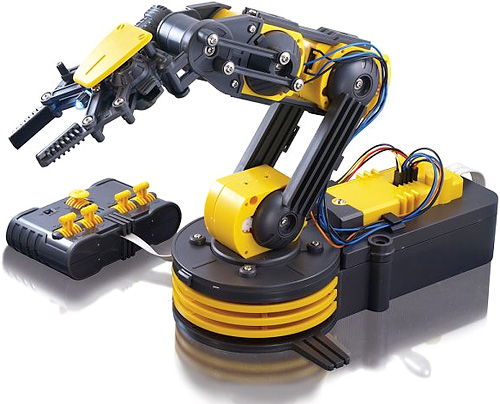
Well On The Way To Your Own Johnny 5 Robot Arm

Robot Arm (Image courtesy RED5)
By Andrew Liszewski

Without a big fat defense contract from the government, how is the average consumer supposed to go about creating their own wise-cracking, sequel-spawning, remake-coming robot sidekick? Since Heathkit never sold a complete Johnny 5 kit, you’ll have to slowly piece together your own. And you can start with this robotic arm available from RED5 for about $60.

While it comes partly disassembled (oh no!) you can put it together without having to do any soldering or wiring. It’s powered by 5 electric motors that allow it to lift a whopping 100g and the arm features a 120 degree wrist pivot, a 300 degree elbow motion and a 180 degree base motion. And if I remember correctly, if you want it to develop some level of sentient intelligence, you’ll need to use it outside during a storm and hope for the best. Just be aware that a lightning strike doesn’t always guarantee it will develop a soul. It sure hasn’t worked for me.


The word robot was introduced to the public by Czech writer Karel Čapek in his play R.U.R. (Rossum's Universal Robots), published in 1920.[14] The play begins in a factory that makes artificial people called robots, but they are closer to the modern ideas of androids and clones, creatures who can be mistaken for humans. They can plainly think for themselves, though they seem happy to serve. At issue is whether the robots are being exploited and the consequences of their treatment.

However, Karel Čapek himself did not coin the word; he wrote a short letter in reference to an etymology in the Oxford English Dictionary in which he named his brother, the painter and writer Josef Čapek, as its actual originator.[14] In an article in the Czech journal Lidové noviny in 1933, he explained that he had originally wanted to call the creatures laboři (from Latin labor, work). However, he did not like the word, and sought advice from his brother Josef, who suggested "roboti". The word robota means literally work, labor or serf labor, and figuratively "drudgery" or "hard work" in Czech and many Slavic languages.[15] Serfdom was outlawed in 1848 in Bohemia, so at the time Čapek wrote R.U.R., usage of the term robota had broadened to include various types of work, but the obsolete sense of "serfdom" would still have been known.[16][17]

The word robotics, used to describe this field of study, was coined (albeit accidentally) by the science fiction writer Isaac Asimov.

History

Many ancient mythologies include artificial people, such as the mechanical servants built by the Greek god Hephaestus[18] (Vulcan to the Romans), the clay golems of Jewish legend and clay giants of Norse legend, and Galatea, the mythical statue of Pygmalion that came to life. In Greek drama, the Deus Ex Machina was contrived, literally God from the machine, as a dramatic device that usually involved lowering a deity, usually Zeus, by wires into the play to solve a seemingly impossible problem.

In the 4th century BC, the Greek mathematician Archytas of Tarentum postulated a mechanical steam-operated bird he called "The Pigeon". Hero of Alexandria (10–70 AD) created numerous user-configurable automated devices, and described machines powered by air pressure, steam and water.[19] Su Song built a clock tower in China in 1088 featuring mechanical figurines that chimed the hours.[20]

Al-Jazari's programmable humanoid robots

Al-Jazari (1136–1206), a Muslim inventor during the Artuqid dynasty, designed and constructed a number of automated machines, including kitchen appliances, musical automata powered by water, and the first programmable humanoid robots in 1206. The robots appeared as four musicians on a boat in a lake, entertaining guests at royal drinking parties. His mechanism had a programmable drum machine with pegs (cams) that bumped into little levers that operated percussion instruments. The drummer could be made to play different rhythms and different drum patterns by moving the pegs to different locations.

[edit] Early modern developments

Tea-serving karakuri, with mechanism, 19th century. Tokyo National Science Museum.
praying walking Alamet, via mechanism, 1889 . Pictures from Yildiz Place by Oktan Keleş.

Leonardo da Vinci (1452–1519) sketched plans for a humanoid robot around 1495. Da Vinci's notebooks, rediscovered in the 1950s, contain detailed drawings of a mechanical knight now known as Leonardo's robot, able to sit up, wave its arms and move its head and jaw.[21] The design was probably based on anatomical research recorded in his Vitruvian Man. It is not known whether he attempted to build it. In 1738 and 1739, Jacques de Vaucanson exhibited several life-sized automatons: a flute player, a pipe player and a duck. The mechanical duck could flap its wings, crane its neck, and swallow food from the exhibitor's hand, and it gave the illusion of digesting its food by excreting matter stored in a hidden compartment.[22] Complex mechanical toys and animals built in Japan in the 1700s were described in the Karakuri zui (Illustrated Machinery, 1796).....In 1889 a Turkish - Ottoman robot had been buit by Ottoman Palace engineers to be sent as a gift to the Japenese Empirer during the period of Abdülhamit II . Its name was ALAMET.That robot had a shape of human nearly with same sizes , ıt had a clock inside some mechanical sisytem to let it move and a voice player to sing the ezan the islamic lyric to call prayer to mosque.it could sing the ezan every hour, it could walk half meter , it could open its arms,ıt could bend forward like a muslim prayer,turn around itself and go back to its place.Its clothes were made of gold and silver.An the robot could sing the ezan every hour.It has still some pictures from the placa of Yıldız in İstanbul.

[edit] Modern developments

The Japanese craftsman Hisashige Tanaka (1799–1881), known as "Japan's Edison" or "Karakuri Giemon", created an array of extremely complex mechanical toys, some of which served tea, fired arrows drawn from a quiver, and even painted a Japanese kanji character.[23] In 1898 Nikola Tesla publicly demonstrated a radio-controlled torpedo.[24] Based on patents for "teleautomation", Tesla hoped to develop it into a weapon system for the US Navy.[25][26]

The first Unimate

In 1926, Westinghouse Electric Corporation created Televox, the first robot put to useful work. They followed Televox with a number of other simple robots, including one called Rastus, made in the crude image of a black man. In the 1930s, they created a humanoid robot known as Elektro for exhibition purposes, including the 1939 and 1940 World's Fairs. [27][28] In 1928, Japan's first robot, Gakutensoku, was designed and constructed by biologist Makoto Nishimura.

The first electronic autonomous robots were created by William Grey Walter of the Burden Neurological Institute at Bristol, England in 1948 and 1949. They were named Elmer and Elsie. These robots could sense light and contact with external objects, and use these stimuli to navigate. [29]

The first truly modern robot, digitally operated and programmable, was invented by George Devol in 1954 and was ultimately called the Unimate. Devol sold the first Unimate to General Motors in 1960, and it was installed in 1961 in a plant in Trenton, New Jersey to lift hot pieces of metal from a die casting machine and stack them.[30]