Well On The Way To Your Own Johnny 5 Robot Arm
By Andrew Liszewski
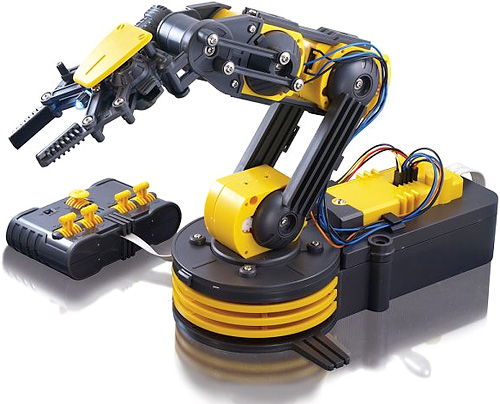
Without a big fat defense contract from the government, how is the average consumer supposed to go about creating their own wise-cracking, sequel-spawning, remake-coming robot sidekick? Since Heathkit never sold a complete Johnny 5 kit, you’ll have to slowly piece together your own. And you can start with this robotic arm available from RED5 for about $60.
While it comes partly disassembled (oh no!) you can put it together without having to do any soldering or wiring. It’s powered by 5 electric motors that allow it to lift a whopping 100g and the arm features a 120 degree wrist pivot, a 300 degree elbow motion and a 180 degree base motion. And if I remember correctly, if you want it to develop some level of sentient intelligence, you’ll need to use it outside during a storm and hope for the best. Just be aware that a lightning strike doesn’t always guarantee it will develop a soul. It sure hasn’t worked for me.
The word robot was introduced to the public by Czech writer Karel Čapek in his play R.U.R. (Rossum's Universal Robots), published in 1920.[14] The play begins in a factory that makes artificial people called robots, but they are closer to the modern ideas of androids and clones, creatures who can be mistaken for humans. They can plainly think for themselves, though they seem happy to serve. At issue is whether the robots are being exploited and the consequences of their treatment.
However, Karel Čapek himself did not coin the word; he wrote a short letter in reference to an etymology in the Oxford English Dictionary in which he named his brother, the painter and writer Josef Čapek, as its actual originator.[14] In an article in the Czech journal Lidové noviny in 1933, he explained that he had originally wanted to call the creatures laboři (from Latin labor, work). However, he did not like the word, and sought advice from his brother Josef, who suggested "roboti". The word robota means literally work, labor or serf labor, and figuratively "drudgery" or "hard work" in Czech and many Slavic languages.[15] Serfdom was outlawed in 1848 in Bohemia, so at the time Čapek wrote R.U.R., usage of the term robota had broadened to include various types of work, but the obsolete sense of "serfdom" would still have been known.[16][17]
The word robotics, used to describe this field of study, was coined (albeit accidentally) by the science fiction writer Isaac Asimov.
History
Many ancient mythologies include artificial people, such as the mechanical servants built by the Greek god Hephaestus[18] (Vulcan to the Romans), the clay golems of Jewish legend and clay giants of Norse legend, and Galatea, the mythical statue of Pygmalion that came to life. In Greek drama, the Deus Ex Machina was contrived, literally God from the machine, as a dramatic device that usually involved lowering a deity, usually Zeus, by wires into the play to solve a seemingly impossible problem.
In the 4th century BC, the Greek mathematician Archytas of Tarentum postulated a mechanical steam-operated bird he called "The Pigeon". Hero of Alexandria (10–70 AD) created numerous user-configurable automated devices, and described machines powered by air pressure, steam and water.[19] Su Song built a clock tower in China in 1088 featuring mechanical figurines that chimed the hours.[20]

Al-Jazari (1136–1206), a Muslim inventor during the Artuqid dynasty, designed and constructed a number of automated machines, including kitchen appliances, musical automata powered by water, and the first programmable humanoid robots in 1206. The robots appeared as four musicians on a boat in a lake, entertaining guests at royal drinking parties. His mechanism had a programmable drum machine with pegs (cams) that bumped into little levers that operated percussion instruments. The drummer could be made to play different rhythms and different drum patterns by moving the pegs to different locations.
[edit] Early modern developments


Leonardo da Vinci (1452–1519) sketched plans for a humanoid robot around 1495. Da Vinci's notebooks, rediscovered in the 1950s, contain detailed drawings of a mechanical knight now known as Leonardo's robot, able to sit up, wave its arms and move its head and jaw.[21] The design was probably based on anatomical research recorded in his Vitruvian Man. It is not known whether he attempted to build it. In 1738 and 1739, Jacques de Vaucanson exhibited several life-sized automatons: a flute player, a pipe player and a duck. The mechanical duck could flap its wings, crane its neck, and swallow food from the exhibitor's hand, and it gave the illusion of digesting its food by excreting matter stored in a hidden compartment.[22] Complex mechanical toys and animals built in Japan in the 1700s were described in the Karakuri zui (Illustrated Machinery, 1796).....In 1889 a Turkish - Ottoman robot had been buit by Ottoman Palace engineers to be sent as a gift to the Japenese Empirer during the period of Abdülhamit II . Its name was ALAMET.That robot had a shape of human nearly with same sizes , ıt had a clock inside some mechanical sisytem to let it move and a voice player to sing the ezan the islamic lyric to call prayer to mosque.it could sing the ezan every hour, it could walk half meter , it could open its arms,ıt could bend forward like a muslim prayer,turn around itself and go back to its place.Its clothes were made of gold and silver.An the robot could sing the ezan every hour.It has still some pictures from the placa of Yıldız in İstanbul.
[edit] Modern developments
The Japanese craftsman Hisashige Tanaka (1799–1881), known as "Japan's Edison" or "Karakuri Giemon", created an array of extremely complex mechanical toys, some of which served tea, fired arrows drawn from a quiver, and even painted a Japanese kanji character.[23] In 1898 Nikola Tesla publicly demonstrated a radio-controlled torpedo.[24] Based on patents for "teleautomation", Tesla hoped to develop it into a weapon system for the US Navy.[25][26]

In 1926, Westinghouse Electric Corporation created Televox, the first robot put to useful work. They followed Televox with a number of other simple robots, including one called Rastus, made in the crude image of a black man. In the 1930s, they created a humanoid robot known as Elektro for exhibition purposes, including the 1939 and 1940 World's Fairs. [27][28] In 1928, Japan's first robot, Gakutensoku, was designed and constructed by biologist Makoto Nishimura.
The first electronic autonomous robots were created by William Grey Walter of the Burden Neurological Institute at Bristol, England in 1948 and 1949. They were named Elmer and Elsie. These robots could sense light and contact with external objects, and use these stimuli to navigate. [29]
The first truly modern robot, digitally operated and programmable, was invented by George Devol in 1954 and was ultimately called the Unimate. Devol sold the first Unimate to General Motors in 1960, and it was installed in 1961 in a plant in Trenton, New Jersey to lift hot pieces of metal from a die casting machine and stack them.[30]


0 comments
Post a Comment