Article Excerpt
An innovative new robotic cutter for reinstating sewer laterals has been introduced to the sewer rehabilitation industry in North America by American Pipe & Plastics Inc., Binghamton, NY.
Two AM Trim Hydrocutter models are available.
* The AT-100 is for use on pipe with diameters from 4 to 9 inches; and
* The self-propelled AT-200 for pipes ranging from 8 to 18 inches in diameter.
What sets them apart from other cutters is how the cutting tool is powered. Unlike the pneumatic tools widely used today, the American Pipe & Plastics (APPI) tools are driven by high-pressure water.
This means that AM-Trim hydrocutter tools are more powerful and cut more effectively than conventional equipment, says Charles Munson, APPI sewer rehabilitation manager.
"Because air is compressible, pneumatic motors may stall during cutting," says Munson. "However, water is incompressible, so when water raider high pressure is used to drive the cutting motor, much greater torque is developed than can be achieved with a pneumatic motor of similar size. Therefore, a hydro-powered motor will continue cutting at loads that would stall the typical pneumatic cutter. Consequently, less time is spent backing the cutter away front the material to allow the cutter motor to start spinning again. The additional power and torque of the hydro motor allow it to turn larger and more aggressive cutting tools than conventional pneumatic cutters, providing faster cutting through even tough materials like fiberglass."
Both AT-100 and AT-200 models include built-in, self-cleaning CCTV (closed-circuit television) cameras, eliminating the need for a separate camera system.
Minimal access
Munson says that because a camera-cutter "train" is not required, an AM-Trim cutter installation requires access from only one manhole, rather than access at each end of a lined pipe as is necessary when using other cutting systems. Also, a winch at a downstream manhole is not required.
"The AT-100 is positioned with push rods from either an upstream or downstream manhole," explains Munson. "The AT-200 is mounted on a hydro-powered wheeled chassis and is 'driven' into position by the person controlling the cutting operation."
Both systems are compact and portable.
"The AT 100 has features that make it especially well suited to work in smaller pipelines," continues Munson. "The cutter can be configured to fit into a lined four-inch diameter pipeline. The rear section of the cutter can be made to articulate, allowing the cutter to negotiate offsets mid bends in the tight confines of a lined small-diameter pipe. Even with its small size and flexibility, it still has the power to cut through the toughest liners."
In addition to the cutting head, the AT-200 has an optional milling head used for hard cutting operations such as removal of protruding taps. The milling head is a gear box connected to the hydro motor which decreases the speed of the cutter and greatly increases the cutting torque.
Basic components of the cutting systems are: tool cutters; cable reel and cable including water supply hose; control and television cables; control box with CCTV viewing screen; and push rods for positioning the AT-t00. High pressure water is provided...
Prof designs little robot to prowl power lines
University of Washington researcher Alexander Mamishev is in the final stage of testing his energy crawler, a 3-inch-tall robot that checks underground high-voltage wires for potential electrical shorts, cracks and damage.
The associate professor of electrical engineering has also started talking to 10 companies and groups interested in commercializing the robot, which uses three sensors to determine the health of electrical cables. Although he declined to identify the parties, he said they include potential private investors as well as power companies.
"This is the first robot built that can inspect power cables autonomously looking for incipient failures," Mamishev said. "It can find cables that may need repair, before they cause problems."
The skinny white robot travels through small cable conduits that are miles and miles long and hard for people to check without digging them up. Today, it is most common to send high voltage down a cable and use acoustics to find cracks, Mamishev said. But this method can increase the size of a crack and make things worse.
Using an automatic sensor robot could extend the life of a cable, he said. Today, about 10 percent of these high transmission cables are housed in underground tunnels or pipes, while the rest are buried in dirt.
Don Von Dollen, program manager for the IntelliGrid Program at the Electric Power Research Institute in Palo Alto, Calif., is unfamiliar with Mamishev's robot crawler but said monitoring high-voltage cables is one of the holy grails of the electricity industry.
"This is something the industry has been working on for 20 years," he said. "It's a tough research challenge to figure out some way of detecting impending failures in cable systems that are difficult to get to. It's a tough nut to crack."
The UW's robot rides inside an insulated distribution cable. Its heat sensor detects heat dissipation, an acoustic sensor listens for the snap and pop of electrical discharges and a third sensor developed by Mamishev detects the presence of moisture that may have seeped into the insulation. The crawler, which runs on a battery, carries a video camera so that operators can monitor its progress.
Power companies spend thousands of dollars estimating the age of cables and replacing them, Mamishev said. Typically, they either wait until a cable fails or replace it after a set period of time -- whether it needs to be replaced or not. Many don't know where the weak points are in their electrical grids or the extent of damage done by hurricanes and floods. Using the robot would help power engineers determine what cables they can maintain or replace, and how they might hold up if they were part of a grid expecting a lot of growth. The robot is designed for underground, not overhead wires, he said.
Some companies have tried to use radar techniques and others have developed sonar applications to solve the problem, Von Dollen said. A lot of solutions have come and gone, he added.
Said Mamishev, "It's just like car maintenance, only more complex and expensive than maintaining a car. And the financial stakes are much higher."
Mamishev started building the robot five years ago and said some 15 people have worked on it over the years. The current team consists of five people, he said. The project has been funded through National Science Foundation and a consortium of power companies, which has invested some $500,000 in the project so far. Mamishev is currently seeking new grants and funding in order to further test the robot.
Mamishev said commercialization is at least a year away. Researchers and engineers are currently making the robot more flexible. They are programming it to bend its arms out of the way in a tight space or extend its arms if the crawler needs stabilization, for instance.
Maintenance tools such as the robot crawler can dramatically reduce the costs associated with power systems, tunnels and buildings, Mamishev said, and he hopes that robots someday will perform many more maintenance tasks.
Feature Articles
Intelligent transportation Systems: A Pipe Dream Whose Components May Already Be on the Road
“Intelligent Transportation Systems” can mean anything from good exit ramp design to autonomous vehicles that can pack a highway efficiently at high speed without causing accidents. While the utopian picture of smart cars on smart roads saving lives and fuel is still impractical, the evolution of technology designed to make driving more convenient, simpler and safer on a car-by-car basis is inching us closer to the point that the addition of a few linchpins will connect the pieces in a way that
Directed Market Expansion and Development Efforts in the Industrial Robotics Industry
To reduce risk and drive revenue, industrial robotics companies are expanding their customer base beyond manufacturing and assembly within large enterprises in the automotive, electronics and semiconductor industries by way of directed market expansion. The rate, scope and variety of industrial robotics directed market expansion efforts provides opportunities to large and small robotics companies, technology providers, systems integrators and distributors, and domain experts alike.
Industry Analysis
Barrett Technology Leads With Technology and Transforms an Industry
After changing the market for robotic manipulators with a practical, safe robotic arm, Barrett is trying to revolutionize the design of all robotic graspers with a small, modular, self-contained general-purpose servomotor controller.
Robotics Technology Consortium the Key to US DoD Ground Robotics Research Funding
The Robotics Technology Consortium (RTC) was created to improve the US Department of Defense’s (DoD) ground robotics technology acquisition process and investment planning, and acts as a facilitator for all of DoD’s joint ground robotics research programs. RTC membership is a must for those companies and research institutions that hope to tap into defense robotics research funding going forward.
Touch Bionics Focuses on i-LIMB Hand, Upper Body Prosthetics
Scotland based Touch Bionics has released the first commercial fully-articulated artificial hand – the well regarded and award winning i-Limb. The product itself, which is the result of more than 20 years of R&D work, looks and acts like a real human hand. As such, the i-Limb is a major advance in bionics and patient care. While the market for prosthetic hands is limited, Touch Bionics has a three year lead over competing commercial products.
Industry Updates
Korea Invests $750 Million in Robotics Industry
Robotics manufacturing is one of the fastest-growing industries in Korea; this investment is designed to make Korea a powerhouse in international robotics as well.
Global Economic Downfall Gets Asyst Technologies Delisted from NASDAQ
Asyst Technologies officials blamed the global economic downturn for declines in sales of flat-panel displays, whose manufacturers were Asyst’s largest customers.
Schilling Extends Robot Arm Product Line With “Dextrous” Atlas 7
The sixth in Schilling’s manipulator product line has greater lift capacity more angle-of-approach options and a longer reach than Schilling’s other arms.
Well On The Way To Your Own Johnny 5 Robot Arm
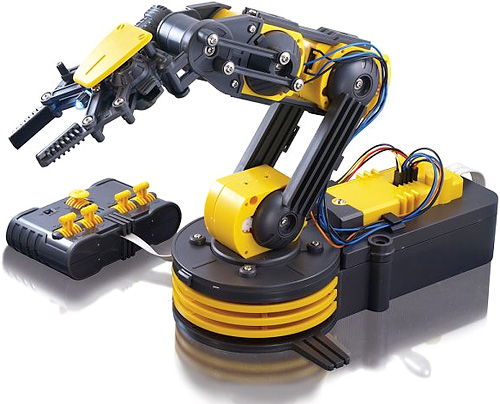
By Andrew Liszewski
Without a big fat defense contract from the government, how is the average consumer supposed to go about creating their own wise-cracking, sequel-spawning, remake-coming robot sidekick? Since Heathkit never sold a complete Johnny 5 kit, you’ll have to slowly piece together your own. And you can start with this robotic arm available from RED5 for about $60.
While it comes partly disassembled (oh no!) you can put it together without having to do any soldering or wiring. It’s powered by 5 electric motors that allow it to lift a whopping 100g and the arm features a 120 degree wrist pivot, a 300 degree elbow motion and a 180 degree base motion. And if I remember correctly, if you want it to develop some level of sentient intelligence, you’ll need to use it outside during a storm and hope for the best. Just be aware that a lightning strike doesn’t always guarantee it will develop a soul. It sure hasn’t worked for me.
The word robot was introduced to the public by Czech writer Karel Čapek in his play R.U.R. (Rossum's Universal Robots), published in 1920.[14] The play begins in a factory that makes artificial people called robots, but they are closer to the modern ideas of androids and clones, creatures who can be mistaken for humans. They can plainly think for themselves, though they seem happy to serve. At issue is whether the robots are being exploited and the consequences of their treatment.
However, Karel Čapek himself did not coin the word; he wrote a short letter in reference to an etymology in the Oxford English Dictionary in which he named his brother, the painter and writer Josef Čapek, as its actual originator.[14] In an article in the Czech journal Lidové noviny in 1933, he explained that he had originally wanted to call the creatures laboři (from Latin labor, work). However, he did not like the word, and sought advice from his brother Josef, who suggested "roboti". The word robota means literally work, labor or serf labor, and figuratively "drudgery" or "hard work" in Czech and many Slavic languages.[15] Serfdom was outlawed in 1848 in Bohemia, so at the time Čapek wrote R.U.R., usage of the term robota had broadened to include various types of work, but the obsolete sense of "serfdom" would still have been known.[16][17]
The word robotics, used to describe this field of study, was coined (albeit accidentally) by the science fiction writer Isaac Asimov.
History
Many ancient mythologies include artificial people, such as the mechanical servants built by the Greek god Hephaestus[18] (Vulcan to the Romans), the clay golems of Jewish legend and clay giants of Norse legend, and Galatea, the mythical statue of Pygmalion that came to life. In Greek drama, the Deus Ex Machina was contrived, literally God from the machine, as a dramatic device that usually involved lowering a deity, usually Zeus, by wires into the play to solve a seemingly impossible problem.
In the 4th century BC, the Greek mathematician Archytas of Tarentum postulated a mechanical steam-operated bird he called "The Pigeon". Hero of Alexandria (10–70 AD) created numerous user-configurable automated devices, and described machines powered by air pressure, steam and water.[19] Su Song built a clock tower in China in 1088 featuring mechanical figurines that chimed the hours.[20]

Al-Jazari (1136–1206), a Muslim inventor during the Artuqid dynasty, designed and constructed a number of automated machines, including kitchen appliances, musical automata powered by water, and the first programmable humanoid robots in 1206. The robots appeared as four musicians on a boat in a lake, entertaining guests at royal drinking parties. His mechanism had a programmable drum machine with pegs (cams) that bumped into little levers that operated percussion instruments. The drummer could be made to play different rhythms and different drum patterns by moving the pegs to different locations.
[edit] Early modern developments


Leonardo da Vinci (1452–1519) sketched plans for a humanoid robot around 1495. Da Vinci's notebooks, rediscovered in the 1950s, contain detailed drawings of a mechanical knight now known as Leonardo's robot, able to sit up, wave its arms and move its head and jaw.[21] The design was probably based on anatomical research recorded in his Vitruvian Man. It is not known whether he attempted to build it. In 1738 and 1739, Jacques de Vaucanson exhibited several life-sized automatons: a flute player, a pipe player and a duck. The mechanical duck could flap its wings, crane its neck, and swallow food from the exhibitor's hand, and it gave the illusion of digesting its food by excreting matter stored in a hidden compartment.[22] Complex mechanical toys and animals built in Japan in the 1700s were described in the Karakuri zui (Illustrated Machinery, 1796).....In 1889 a Turkish - Ottoman robot had been buit by Ottoman Palace engineers to be sent as a gift to the Japenese Empirer during the period of Abdülhamit II . Its name was ALAMET.That robot had a shape of human nearly with same sizes , ıt had a clock inside some mechanical sisytem to let it move and a voice player to sing the ezan the islamic lyric to call prayer to mosque.it could sing the ezan every hour, it could walk half meter , it could open its arms,ıt could bend forward like a muslim prayer,turn around itself and go back to its place.Its clothes were made of gold and silver.An the robot could sing the ezan every hour.It has still some pictures from the placa of Yıldız in İstanbul.
[edit] Modern developments
The Japanese craftsman Hisashige Tanaka (1799–1881), known as "Japan's Edison" or "Karakuri Giemon", created an array of extremely complex mechanical toys, some of which served tea, fired arrows drawn from a quiver, and even painted a Japanese kanji character.[23] In 1898 Nikola Tesla publicly demonstrated a radio-controlled torpedo.[24] Based on patents for "teleautomation", Tesla hoped to develop it into a weapon system for the US Navy.[25][26]

In 1926, Westinghouse Electric Corporation created Televox, the first robot put to useful work. They followed Televox with a number of other simple robots, including one called Rastus, made in the crude image of a black man. In the 1930s, they created a humanoid robot known as Elektro for exhibition purposes, including the 1939 and 1940 World's Fairs. [27][28] In 1928, Japan's first robot, Gakutensoku, was designed and constructed by biologist Makoto Nishimura.
The first electronic autonomous robots were created by William Grey Walter of the Burden Neurological Institute at Bristol, England in 1948 and 1949. They were named Elmer and Elsie. These robots could sense light and contact with external objects, and use these stimuli to navigate. [29]
The first truly modern robot, digitally operated and programmable, was invented by George Devol in 1954 and was ultimately called the Unimate. Devol sold the first Unimate to General Motors in 1960, and it was installed in 1961 in a plant in Trenton, New Jersey to lift hot pieces of metal from a die casting machine and stack them.[30]
Electronica includes a wide range of contemporary electronic music designed for a wide range of uses, including foreground listening, some forms of dancing, and background music for other activities; however, unlike electronic dance music, it is not specifically made for dancing.[1][2] The term was first used in the United States in the early 1990s with regards to post-rave global-influenced electronic dance music.[citation needed] Genres such as techno, drum and bass, downtempo, and ambient are among those encompassed by the umbrella term, entering the American mainstream from "alternative" or "underground" venues during the late 1990s.[2][3] Prior to the adoption of electronica for this purpose, terms such as electronic listening music, and intelligent dance music (IDM) were used.[citation needed]
Allmusic categorises electronica as a top-level genre on their main page, where they state that electronica includes "dozens of stylistic fusions" ranging from danceable grooves to music for headphones and chillout areas.[4]
Electronica has grown to influence mainstream crossover recordings. Electronic sounds began to form the basis of a wide array of popular music in the late 1970s, and became key to the mainstream pop and rock sounds of the 1980s. Since the adoption of "electronica" in the 1990s to describe more underground music with an electronic aesthetic, elements of modern electronica have been adopted by many popular artists in mainstream music.[5][6]
Contents[hide] |
[edit] A wave of diverse acts
Electronica was made possible by advancements in music technology, especially electronic musical instruments, synthesizers, music sequencers, drum machines, digital audio workstations[citation needed]. Early forms of electronic music required large amounts of complex equipment and multiple operators for live performances, and multiple engineers to record the music at high quality.[citation needed] As the technology developed, it became possible for individuals or smaller groups to produce electronic songs and recordings in smaller studios, even in project studios. At the same time, computers facilitated the use of music "samples" and "loops" as construction kits for sonic compositions. [7] This led to a period of creative experimentation and the development of new forms, some of which became known as electronica. [5][8]
In the mid-1990s, electronica began to be used by MTV and major record labels to describe mainstream electronic dance music made by such artists as Orbital (who had previously been described as ambient) and The Prodigy.[citation needed] It is currently used to describe a wide variety of musical acts and styles, linked by a penchant for overtly electronic production; [9] a range which includes more popular acts such as Björk, Goldfrapp and Braindance artists such as Autechre, and Aphex Twin to dub-oriented downtempo, downbeat, and trip-hop. Madonna and Björk are said to be responsible for electronica's thrust into mainstream culture, with their albums Ray of Light (Madonna),[6] Post and Homogenic (Björk). Electronica artists that would later become commercially successful began to record in this early 1990s period, before the term had come into common usage, including for example Fatboy Slim, Fœtus, Daft Punk, The Chemical Brothers, The Crystal Method, Moby, Underworld and Faithless. [10] A focus on "songs", a fusion of styles and a combination of traditional and electronic instruments often sets apart musicians working in electronic-styles over more straight-ahead styles of house, techno and trance.[citation needed] Electronica composers often create alternate versions of their compositions, known as "remixes"; this practice also occurs in related musical forms such as ambient, jungle, and electronic dance music. [11] Wide ranges of influences, both sonic and compositional, are combined in electronica recordings. [12]
The more abstract Autechre and Aphex Twin around this time were releasing early records in the "intelligent techno" or so-called intelligent dance music (IDM) style, while other Bristol-based musicians such as Tricky, Leftfield, Massive Attack and Portishead were experimenting with the fusion of electronic textures with hip-hop, R&B rhythms to form what became known as trip-hop. Later extensions to the trip hop aesthetic around 1997 came from the highly influential Vienna-based duo of Kruder & Dorfmeister, whose blunted, dubbed-out, slowed beats became the blueprint for the new style of downtempo. Roni Size, Goldie and Omni Trio commanded attention in the UK as exemplars of the drum and bass genre.[citation needed]
It could be noted that older bands such as New Order and Depeche Mode had built on the new wave music of the 1980s and added more dance and electronic instrumentation and alternative rock influences to become early pioneers of "electronica" music. These two groups are very commonly cited as being hugely influential to the first generations of underground and later, alternative electronica artists.[citation needed]
[edit] Global patterns of popularity
By the late 1990s, artists like Moby had become internationally famous, releasing albums and performing regularly in major venues. In the United States and other countries like Australia, electronica (and the other attendant dance music genres) remained popular, although largely underground, while in Europe it had become one of the most dominant forms of popular music.[citation needed]
In the late 1990s and early 2000s, Electronica's maturing sound embraced multi-cultural influences both through the increasing commercial availability of audio sample libraries of musical instruments from around the globe, as well as cross-pollination with DJs, performers and recording artists from many nations.[citation needed] New York City became one center of experimentation and growth for the electronica sound, with DJs and music producers from areas as diverse as Southeast Asia and Brazil brought their creative work to the nightclubs of that city. [13] [14]
The Norwegian dance duo Röyksopp reached unexpected stardom in 2001 when its debut album Melody AM became an international bestseller. By 2002 the style had a harder edge and in the UK tracks like “Loneliness” by Tomcraft hit number One and the following year an electro dance scene emerged in the UK. The release of albums like “New Wave Electro” on Orange Sync Records and Electrotech Ministry of Sound introduced this style to the clubs with post punk beats, mono Synth breaks which became the formula for the current electro dance scene in the UK.[citation needed]
[edit] Effect on mainstream popular music
Around the mid-1990s, with the success of the big beat-sound exemplified by The Chemical Brothers and The Prodigy in the UK, and spurred by the attention from mainstream artists, including Madonna in her collaboration with William Orbit on Ray of Light,[6] music of this period began to be produced with a higher budget, increased technical quality, and with more layers than most other forms of dance music, since it was backed by major record labels and MTV as the "next big thing".[15]
According to a 1997 Billboard article, "[t]he union of the club community and independent labels" provided the experimental and trend-setting environment in which electronica acts developed and eventually reached the mainstream. It cites American labels such as Astralwerks (The Future Sound of London, Fluke), Moonshine (DJ Keoki), Sims, and City of Angels (The Crystal Method) for playing a significant role in discovering and marketing artists who became popularized in the electronica scene.[2]
The adoption of elements of electronica by several of the world's most popular rock bands was also seen beginning in the mid 1990s, for example U2's Zooropa (1993) and Pop (1997) albums, Radiohead's OK Computer (1997), R.E.M.'s Up (1998), The Smashing Pumpkins' Adore (1998), Blur's 13 (1999) and Oasis's Standing on the Shoulder of Giants (2000) albums.[citation needed] Several of these albums were produced with electronic dance producers, such as William Orbit who produced both Madonna's Ray of Light. and Blur's 13.[citation needed] Radiohead's 2000 follow-up to OK Computer, Kid A, found one of the most polarised critical receptions for an adoption of electronic sounds by a rock group, but the album also received wide acclaim, and the band cited their debts to a large number of electronic musicians, such as Autechre and Boards of Canada, in a recording which reached #1 on the US album charts. The word "electronica" was commonly applied to such releases despite large differences in style.[citation needed] Indeed, by the late 1990s, the word was mostly used by rock fans to describe rock and pop artists' adoption of electronic music textures (such as samples, synthesizers and drum machines) with which they were otherwise unfamiliar, as well as to label a few dance-oriented acts that achieved popularity.[citation needed] This was particularly true in the US where the electronic dance subculture was much less prominent.[citation needed]
In the early 2000s, electronica-inspired post punk experienced a revival, with rock bands such as Interpol and The Killers specifically drawing on the 1980s sound of New Order and The Cure. Russian duet t.A.T.u. use electronica styles extensively, and fuse it with pop styles to form an edgy electronica style.[citation needed]
With newly prominent music styles such as reggaeton, and subgenres such as electroclash, and favela funk, electronic music styles in the current decade are seen to permeate nearly all genres of the mainstream and indie landscape such that a distinct "electronica" genre of pop music is rarely noted. However, the word continues to be more common in the U.S. music industry for synthesized, techno-inspired pop music, as specific genres such as drum and bass and IDM never achieved mainstream attention.[citation needed]
[edit] Hip hop fusion
Hip hop DJs and producers had been mining electronic sounds to create beats since Afrika Bambaataa and Grandmaster Flash pioneered the use of drum machines and synthesizers in the early 1980s, and the hip hop genre shared with other forms of electronic music an emphasis on sampling. Beginning with the success of Dr. Dre and G-funk rap in the mid 1990s, many hip hop producers began turning to a more synthesized sound, resulting in the rise of "superproducers" such as The Neptunes, who cultivated a science fiction image with sleek, overtly electronic beats, and Timbaland, who did likewise and also was known for creative sampling, rising to fame for his work with Aaliyah and Missy Elliott and producing a variety of pop and R&B records for artists such as Justin Timberlake. Timberlake's 2006 hit songs "SexyBack" and "My Love", both produced by Timbaland, were particularly notable for their electronic aesthetic, while The Neptunes worked with a range of acts from Britney Spears to Jay-Z.
A variety of other hip hop performers used electronica-influenced sounds as hooks in their songs. Outkast, a popular and acclaimed hip hop duo, adopted sounds in their 2003 hit single "Hey Ya" and member/producer Andre Benjamin praised the music of Squarepusher. In 2007 Kanye West, initially known for more natural sounding hip hop productions influenced by classic R&B music, released his third album Graduation, which featured some songs with a sharp electronic aesthetic, a sound which greatly expanded on West's latest album, where he emphasized synthesizer and vocal manipulations prominently and cited major influences from 1980s synth pop music, as well as from T-Pain, a hip-hop performer known for manipulating his voice by using the electronic program Autotune. However, West's 2007 single "Stronger" used a prominent sample from a song by the French dance-oriented electronic act Daft Punk, whose work in the 1990s and early 2000s was also becoming highly sampled and influential on the musical aesthetic of acts in other genres such as indie rock and indie dance.
[edit] TV Influence
In the late 1990s and early 2000s, electronica music was increasingly used as background scores for television advertisements, initially for automobiles. It was also used for various videogames -- specifically Wipeout (video game series): a sci-fi combat hovercraft racer for which the soundtrack was composed of many popular and highly-appropriate electronica tracks that helped create more interest in this type of music[16] -- and later for other technological and business products such as computers and financial services.
[edit] See also
[edit] Further reading
- Cummins, James. 2008. Ambrosia: About a Culture - An Investigation of Electronica Music and Party Culture. Toronto, ON: Clark-Nova Books. ISBN 978-0-978489-21-2
[edit] References
- ^ "Electronica is a broad term used to describe the emergence of electronic music that is geared for listening instead of strictly for dancing." The Techno Primer: The Essential Reference for Loop-Based Music Styles, By Tony Verderosa, page 28, Hal Leonard Music/Songbooks ,2002, ISBN 0634017888
- ^ a b c Flick, Larry (May 24, 1997), "Dancing to the beat of an indie drum", Billboard 109 (21): 70–71, ISSN 0006-2510
- ^ "The glitch genre arrived on the back of the electronica movement, an umbrella term for alternative, largely dance-based electronic music (including house, techno, electro, drum'n'bass, ambient) that has come into vogue in the past five years. Most of the work in this area is released on labels peripherally associated with the dance music market, and is therefore removed from the contexts of academic consideration and acceptability that it might otherwise earn. Still, in spite of this odd pairing of fashion and art music, the composers of glitch often draw their inspiration from the masters of 20th century music who they feel best describe its lineage." THE AESTHETICS OF FAILURE: 'Post-Digital' Tendencies in Contemporary Computer Music, Kim Cascone, Computer Music Journal 24:4 Winter 2002 (MIT Press)
- ^ "'Reaching back to grab the grooves of '70s disco/funk and the gadgets of electronic composition, Electronica soon became a whole new entity in and of itself, spinning off new sounds and subgenres with no end in sight two decades down the pike. Its beginnings came in the post-disco environment of Chicago/New York and Detroit, the cities who spawned house and techno (respectively) during the 1980s. Later that decade, club-goers in Britain latched onto the fusion of mechanical and sensual, and returned the favor to hungry Americans with new styles like jungle/drum'n'bass and trip-hop. Though most all early electronica was danceable, by the beginning of the '90s, producers were also making music for the headphones and chill-out areas as well, resulting in dozens of stylistic fusions like ambient-house, experimental techno, tech-house, electro-techno, etc. Typical for the many styles gathered under the umbrella was a focus on danceable grooves, very loose song structure (if any), and, in many producers, a relentless desire to find a new sound no matter how tepid the results." Electronica Genre at Allmusic
- ^ a b "Electronically produced music is part of the mainstream of popular culture. Musical concepts that were once considered radical - the use of environmental sounds, ambient music, turntable music, digital sampling, computer music, the electronic modification of acoustic sounds, and music made from fragments of speech-have now been subsumed by many kinds of popular music. Record store genres including new age, rap, hip-hop, electronica, techno, jazz, and popular song all rely heavily on production values and techniques that originated with classic electronic music." Page 1, Electronic and Experimental Music: Pioneers in Technology and Composition, Thomas B. Holmes, Routledge Music/Songbooks, 2002, ISBN 0415936438
- ^ a b c "Billboard: Madonna Hung Out on the Radio". Billboard (VNU Media). July 2006. http://www.billboard.com/bbcom/news/article_display.jsp?vnu_content_id=1002877666.
- ^ "This loop slicing technique is common to the electronica genre and allows a live drum feel with added flexibility and variation." Page 380, DirectX Audio Exposed: Interactive Audio Development, Todd Fay, Wordware Publishing, 2003, ISBN 1556222882
- ^ "Electronica and punk have a definite similarity: They both totally prescribe to a DIY aesthetic. We both tried to work within the constructs of the traditional music business, but the system didn't get us - so we found a way to do it for ourselves, before it became affordable.", quote from artist BT, page 45, Wired: Musicians' Home Studios : Tools & Techniques of the Musical Mavericks, Megan Perry, Backbeat Books Music/Songbooks 2004, ISBN 0879307943
- ^ "Electronica lives and dies by its grooves, fat synthesizer patches, and fliter sweeps.". Page 376, DirectX Audio Exposed: Interactive Audio Development, Todd Fay, Wordware Publishing, 2003, ISBN 1556222882
- ^ "Crystal Method...grew from an obscure club-culture duo to one of the most recognizable acts in electronica, ...", page 90, Wired: Musicians' Home Studios : Tools & Techniques of the Musical Mavericks, Megan Perry, Backbeat Books Music/Songbooks 2004, ISBN 0879307943
- ^ "For example, composers often render more than one version of their own compositions. This practice is not unique to the mod scene, of course, and occurs commonly in dance club music and related forms (such as ambient, jungle, etc.—all broadly designated 'electronica')." Page 48, Music and Technoculture, Rene T. A. Lysloff, Tandem Library Books, 2003, ISBN 0613912500
- ^ Pages 233 & 242, Popular Music in France from Chanson to Techno: Culture, Identity and Society , By Steve Cannon, Hugh Dauncey, Ashgate Publishing, Ltd. 2003, ISBN 0754608492
- ^ "In 2000 [Brazilian vocalist Bebel] Gilberto capitalized on New York's growing fixation with cocktail lounge ambient music, an offshoot of the dance club scene that focused on drum and bass remixes with Braziian sources. ...Collaborating with club music maestros like Suba and Thievery Corporation, Gilberto thrust herself into the leading edge of the emerging Brazilian electronica movement. On her immensely popular Tanto Tempo (2000)..." Page 234, The Latin Beat: The Rhythms and Roots of Latin Music from Bossa Nova to Salsa and Beyond, Ed Morales, Da Capo Press, 2003, ISBN 0306810182
- ^ "founded in 1997,...under the slogan 'Musical Insurgency Across All Borders', for six years [Manhattan nightclub] Mutiny was an international hub of the south Asian electronica music scene. Bringing together artists from different parts of the south Asia diaspora, the club was host to a roster of British Asian musicians and DJs..." Page 165, Youth Media , Bill Osgerby, Routledge, 2004, ISBN 0415238072
- ^ "Electronica reached new heights within the culture of rave and techno music in the 1990s." Page 185, Music and Technoculture, Rene T. A. Lysloff, Tandem Library Books, 2003, ISBN 0613912500
- ^ The Changing Shape of the Culture Industry; or, How Did Electronica Music Get into Television Commercials?, Timothy D. Taylor, University of California, Los Angeles, Television & New Media, Vol. 8, No. 3, 235-258 (2007)
please search you want:
Electronics
Accessories & Supplies
Audio & Video
Camera & Photo
Car Electronics
Computers & Add-Ons
GPS & Navigation
Home Audio & Theater
Marine Electronics
Office Electronics
Portable Audio & Video
Security & Surveillance
Service & Replacement Plans
Televisions & Video
Kitchen & Housewares
Bar Tools & Glasses
Coffee, Tea & Espresso
Cookware & Baking
Dining Room Furniture
Home Brewing & Wine Making
Kitchen & Table Linens
Kitchen Furniture
Kitchen Knives & Cutlery Accessories
Kitchen Utensils & Gadgets
Small Appliance Accessories
Small Appliances
Storage & Organization
Tableware
Wine Accessories
(FSB) -- When Mark Bitterman, who calls himself a "selmelier," was trying to pump up sales at his gourmet salt shop, he knew standard marketing techniques such as radio ads and direct mail wouldn't be enough.
Seeking to capture the imagination of educated, adventurous gourmand prospective customers, he instead set out to draw more people to his Web site and his Portland, Ore., shop by writing an informative, entertaining and provocative blog, "Salt News."
Bitterman knows that people, including reporters, visit both the site and the blog, and many eventually come through the doors to see the 60 or so varieties of salt.
"You can't tell if it gets you new traffic or if it just shapes the expectations of those who come to the shop," he adds.
There are probably as many varieties of marketing a business and increasing sales as there are versions of high-end salt. But you can't expect to compete as a small business today without choosing from a growing arsenal of online marketing tools. Here are four smart ways to get your business noticed on the Internet.
1. Create a simple, effective Web site.
Does your Web site describe your product or service in a succinct, compelling and visual fashion? Does it answer potential customers' needs in, say, less than 10 seconds?
"Once they click to your Web site, you have between 5 and 8 seconds to convince them you can help," says Larry Bailin, CEO of SingleThrow Internet Marketing in Wall, N.J., and author of the soon-to-be-published Mommy, Where Do Customers Come From? (Larstan Publishing).
Your home page should include the bare essentials, Bailin says. "People are looking for exactly what they typed in, with calls to action," he says. "It's critical that you address their issues on your home page. Get to the point and get rid of anything that doesn't need to be there."
Your Web site should be easy to navigate and right on target, and a "Contact Us" button should be prominent.
Also, make sure your site appears high on search engines' results pages. By including keywords and terms in the code, your site will appear higher up on Google and others. These days, any good web designer will be able to handle such search engine marketing as part of the design and programming package. Still, it's up to you to know the best way to describe your product and service to potential customers and then turn them into qualified sales leads.
"Don't think too much about the bells and whistles," warns Bailin. "Think about the connection that you're going to make and the way you're going to help people. Make it clear to them and you'll win every time."
2. Become a blogger.
Entrepreneurs who blog can reach a new audience by writing in a conversational way and showing the human and personal side of their business, according to William Beutler, senior online analyst for New Media Strategies, a Web 2.0 marketing firm in Arlington, Va.
"Make your industry interesting to people by writing in a conversational manner," he says. "Give people a glimpse into a world they don't know."
Beutler believes new businesses can benefit greatly from blogging. "There's still an untapped audience in a lot of industries that are just starting to grow," he says. "You have the potential to establish yourself as an expert in the field just by being the first person to write something interesting about your field."
3. Try podcasting.
Podcasting is a relatively simple technology that is being taken quite seriously by some Fortune 500 companies. And all you really need to get started is a decent microphone, a digital recorder and editing software.
Podcasts allow you to make the most of your inner impresario, plus, your show and the subscriber audience it may lure can give you an edge over competitors.
"Podcasting is still unique enough in many industries that it can allow you to stand out a bit," says John Jantsch, a Kansas City, Mo., marketing coach and author of Duct Tape Marketing: The World's Most Practical Small Business Marketing Guide (Thomas Nelson).
"Podcasting makes a ton of sense for many small businesses for several reasons," says Jantsch. "A voice, rather than simple words on a paper can convey emotion and personality. It's much easier to connect to that."
Jantsch offers this tip for the podcaster trying to bring attention to his business: "Invite a key strategic partner to be a guest on the podcast and you're likely to get the attention of high-level experts, authors and even prospects."
4. Smile, you're on YouTube!
YouTube is not just for classic media clips, cute pet tricks and bizarre dorm antics anymore. With a YouTube link on your Web site and vice versa, you have a new marketing tool. But don't be so crass as to post blatant infomercials about your small business.
"What you want to post is something that the people on YouTube will find interesting or useful and will therefore watch," says Michael Miller, the Indianapolis-based author of YouTube 4 (Que Publishing).
GELOMBANG LAUT (OCEAN WAVES)
April 13th, 2008 · & Komentar
Gelombang · Oseanografi · Teknik Pantai · Teknik Sipil
 Gelombang/ombak yang terjadi di lautan dapat diklasifikasikan menjadi beberapa macam tergantung kepada gaya pembangkitnya. Pembangkit gelombang laut dapat disebabkan oleh: angin (gelombang angin), gaya tarik menarik bumi-bulan-matahari (gelombang pasang-surut), gempa (vulkanik atau tektonik) di dasar laut (gelombang tsunami), ataupun gelombang yang disebabkan oleh gerakan kapal.
Gelombang yang sehari-hari terjadi dan diperhitungkan dalam bidang teknik pantai adalah gelombang angin dan pasang-surut (pasut). Gelombang dapat membentuk dan merusak pantai dan berpengaruh pada bangunan-bangunan pantai. Energi gelombang akan membangkitkan arus dan mempengaruhi pergerakan sedimen dalam arah tegak lurus pantai (cross-shore) dan sejajar pantai (longshore). Pada perencanaan teknis bidang teknik pantai, gelombang merupakan faktor utama yang diperhitungkan karena akan menyebabkan gaya-gaya yang bekerja pada bangunan pantai.
DEFINISI GELOMBANG
Apa yang dimaksud dengan gelombang?
Gelombang adalah pergerakan naik dan turunnya air dengan arah tegak lurus permukaan air laut yang membentuk kurva/grafik sinusoidal. Gelombang laut disebabkan oleh angin. Angin di atas lautan mentransfer energinya ke perairan, menyebabkan riak-riak, alun/bukit, dan berubah menjadi apa yang kita sebut sebagai gelombang.


Animasi pergerakan partikel zat cair pada gelombang
Amati gerak pelampung di dalam gambar animasi gelombang di atas. Perhatikan bahwa sebenarnya pelampung bergerak dalam suatu lingkaran (orbital) ketika gelombang bergerak naik dan turun. Partikel air berada dalam satu tempat, bergerak di suatu lingkaran, naik dan turun dengan suatu gerakan kecil dari sisi satu kembali ke sisi semula. Gerakan ini memberi gambaran suatu bentuk gelombang. Pelampung yang mengapung di air pindah ke pola yang sama, naik turun di suatu lingkaran yang lambat, yang dibawa oleh pergerakan air.
Di bawah permukaan, gerakan berputar gelombang itu semakin mengecil. Ada gerak orbital yang mengecil seiring dengan kedalaman air, sehingga kemudian di dasar hanya akan meninggalkan suatu gerakan kecil mendatar dari sisi ke sisi yang disebut “surge” .
PENGARUH GELOMBANG
Pada kondisi sesungguhnya di alam, pergerakan orbital di perairan dangkal (shallow water) dekat dengan kawasan pantai dapat dilihat pada gambar animasi dibawah ini. Pada gambar animasi ini, dapatlah kita bayangkan bagaimana energi gelombang mampu mempengaruhi kondisi pantai.
Simulasi pergerakan partikel air saat penjalaran gelombang menuju pantai
Ketinggian dan periode gelombang tergantung kepada panjang fetch pembangkitannya. Fetch adalah jarak perjalanan tempuh gelombang dari awal pembangkitannya. Fetch ini dibatasi oleh bentuk daratan yang mengelilingi laut. Semakin panjang jarak fetchnya, ketinggian gelombangnya akan semakin besar. Angin juga mempunyai pengaruh yang penting pada ketinggian gelombang. Angin yang lebih kuat akan menghasilkan gelombang yang lebih besar.
Gelombang yang menjalar dari laut dalam (deep water) menuju ke pantai akan mengalami perubahan bentuk karena adanya perubahan kedalaman laut. Apabila gelombang bergerak mendekati pantai, pergerakan gelombang di bagian bawah yang berbatasan dengan dasar laut akan melambat. Ini adalah akibat dari friksi/gesekan antara air dan dasar pantai. Sementara itu, bagian atas gelombang di permukaan air akan terus melaju. Semakin menuju ke pantai, puncak gelombang akan semakin tajam dan lembahnya akan semakin datar. Fenomena ini yang menyebabkan gelombang tersebut kemudian pecah.

Perubahan bentuk gelombang yang menjalar mendekati pantai
Ada dua tipe gelombang, bila dipandang dari sisi sifat-sifatnya. Yaitu:
- Gelombang pembangun/pembentuk pantai (Constructive wave).
- Gelombang perusak pantai (Destructive wave).
Yang termasuk gelombang pembentuk pantai, bercirikan mempunyai ketinggian kecil dan kecepatan rambatnya rendah. Sehingga saat gelombang tersebut pecah di pantai akan mengangkut sedimen (material pantai). Material pantai akan tertinggal di pantai (deposit) ketika aliran balik dari gelombang pecah meresap ke dalam pasir atau pelan-pelan mengalir kembali ke laut.

Gelombang pembentuk pantai
Sedangkan gelombang perusak pantai biasanya mempunyai ketinggian dan kecepatan rambat yang besar (sangat tinggi). Air yang kembali berputar mempunyai lebih sedikit waktu untuk meresap ke dalam pasir. Ketika gelombang datang kembali menghantam pantai akan ada banyak volume air yang terkumpul dan mengangkut material pantai menuju ke tengah laut atau ke tempat lain.

Gelombang perusak pantai
oooOOOooo


